6 min read
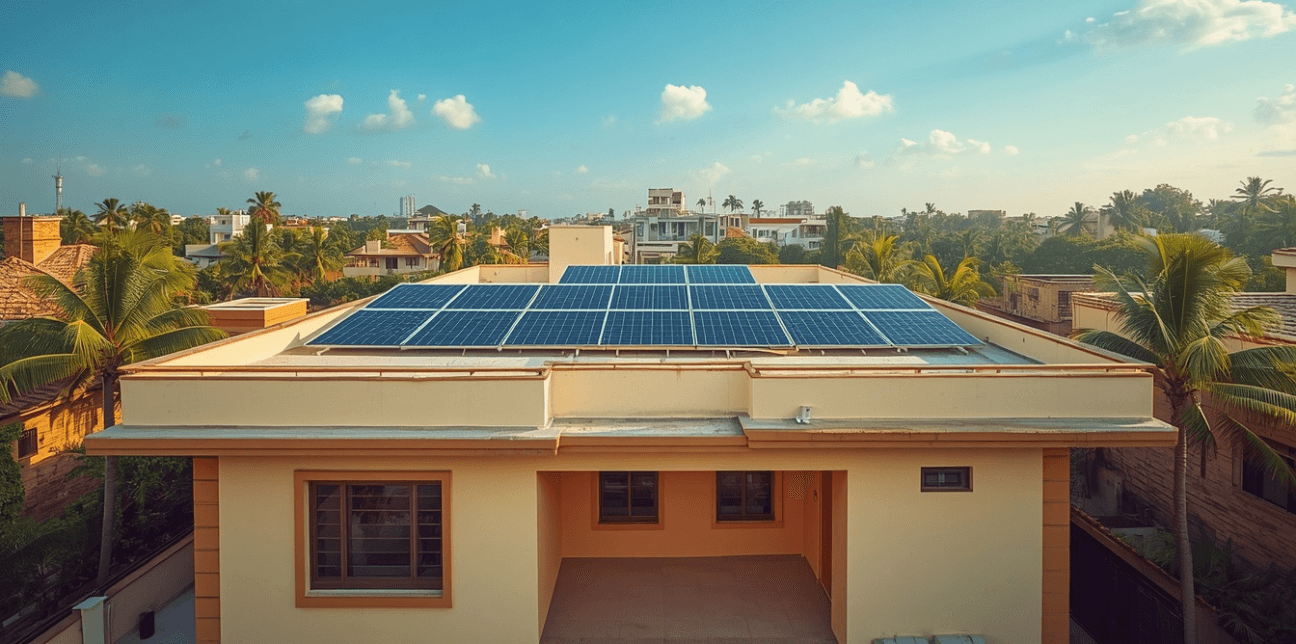
Solar energy has never been more accessible or more affordable in India than it is right now. Panel prices have dropped significantly over the past decade, government subsidies have become more generous, and the number of qualified installers has grown across every major city.
But if you search for solar costs online you will find wildly different numbers, ₹40,000 here, ₹4,00,000 there, with very little explanation of why the range is so large or what you should actually expect to pay for your specific situation.
This guide breaks it down completely. By the time you finish reading you will know exactly what a rooftop solar system costs in India in 2026, what drives those costs up or down, what subsidies are available, and what return on investment you can realistically expect.Why Solar Costs Vary So Much
Why Solar Costs Vary So Much Across India
Ask ten solar companies for a quote and you will get ten different numbers. That is not because solar companies are being dishonest it is because the cost of a rooftop solar system genuinely depends on several variables that are specific to your property, your location, and your electricity consumption.
Here is what actually determines the price:
System Size: The single biggest factor. Solar systems are measured in kilowatts, KW. A larger system generates more power, requires more panels, a larger inverter, more mounting hardware, and more installation labour. The right system size for your home is determined by your monthly electricity consumption and your available rooftop space, not by a standard package.
Panel Quality and Brand: Premium monocrystalline panels from established manufacturers are more efficient and more durable than budget polycrystalline panels. They cost more upfront but generate more power per square metre and maintain performance better over their 25-year lifespan. Choosing cheaper panels to save money today often costs significantly more in lost generation over two decades.
Inverter Type: The inverter converts the DC power your panels generate into usable AC power. String inverters are the standard and most cost-effective option. Microinverters work better for rooftops with partial shading but cost more. Hybrid inverters are required for systems with battery backup and carry a premium over standard string inverters.
System Type: On grid, hybrid, or off grid, each system type has a different cost profile. On grid is the most affordable. Hybrid adds battery storage and costs more. Off grid requires the largest battery bank and is the most expensive.
Installation Complexity: Flat concrete rooftop is straightforward. A sloped tile or mangalore tile rooftop requires additional mounting work. A rooftop with partial shading from water tanks, trees, or adjacent buildings requires more careful system design. A multi-storey building requires more complex wiring runs. These factors affect both labour time and material requirements.
Location and Local Labour Costs: Installation labour costs vary across India. Bengaluru, Mumbai, and Delhi generally have slightly higher installation costs than smaller cities. However panel and inverter prices are broadly similar across India since most components are imported or manufactured nationally.
Rooftop Solar Cost by System Size | India 2026
These are realistic price ranges for quality installations across India in 2026. All prices include panels, inverter, mounting structure, wiring, installation labour, and basic commissioning. Battery storage is not included unless specified.
1 KW System: Approximate cost: ₹55,000 - ₹80,000 Monthly generation: 90 - 120 units Suitable for: Very small homes, single room apartments, minimal consumption Best for: Homes with a monthly BESCOM or electricity board bill under ₹800
2 KW System: Approximate cost: ₹1,10,000 - ₹1,50,000 Monthly generation: 180 - 240 units Suitable for: 1BHK homes and small 2BHK apartments Best for: Homes consuming 150 - 220 units per month
3 KW System: Approximate cost: ₹1,60,000 - ₹2,20,000 Monthly generation: 270 - 360 units Suitable for: Standard 2BHK and 3BHK homes Best for: The most commonly installed residential system size in India, suits most urban households
5 KW System: Approximate cost: ₹2,60,000 - ₹3,60,000 Monthly generation: 450 - 600 units Suitable for: Large 3BHK and 4BHK homes, small offices Best for: High-consumption homes with multiple air conditioners, large appliances, or home offices
10 KW System: Approximate cost: ₹5,00,000 - ₹7,00,000 Monthly generation: 900 - 1200 units Suitable for: Very large homes, small commercial properties, housing society common areas Best for: Properties with very high consumption or multiple units sharing one connection
Higher capacity systems, 20KW and above: For commercial properties, factories, warehouses, and large institutional buildings. Pricing is highly variable and depends entirely on site-specific factors. A detailed site assessment and custom design is required before any meaningful cost estimate can be provided.
Cost by System Type
On Grid System (Most Affordable): Connects your rooftop solar directly to the state electricity grid. You use solar power during the day and draw from the grid at night or on cloudy days. Excess power you generate feeds back to the grid earning you net metering credits that reduce your electricity bill.
This is the most affordable solar option because it requires no battery storage. The base system costs above apply to on grid systems.
One important limitation on grid systems shut down automatically during power cuts as a safety measure. If your area has frequent load shedding this may be a significant drawback.
Hybrid System (Best for Power Cut Protection): Combines grid connection with battery storage. Your excess solar power charges the batteries instead of going to the grid and you use that stored power during power cuts or at night. This gives you both bill reduction and backup power.
Additional cost over on grid: ₹80,000 - ₹2,50,000 depending on battery capacity and chemistry. Lithium iron phosphate batteries are the best choice, they last 10 to 15 years and perform well in Indian heat conditions. Lead acid batteries cost less upfront but need replacement every 3 to 5 years and perform poorly in high temperatures.
Off Grid System (Complete Energy Independence): Operates entirely independently from the grid. No electricity board connection required or used. All power comes from solar panels and battery storage.
This is the most expensive option because you need enough battery capacity to power your home through the night and through overcast days without any grid backup.
Additional cost over on grid: ₹1,50,000 - ₹4,00,000 or more depending on the battery bank size required.
Best for properties in areas with very unreliable grid supply or remote locations where grid connectivity is unavailable or not cost effective.
Government Subsidies Available in 2026
The Government of India offers significant subsidies for residential rooftop solar installations under the PM Surya Ghar Muft Bijli Yojana scheme. This is one of the most generous solar subsidy programs in the world and directly reduces your installation cost.
The subsidy structure for 2026 is as follows for residential customers:
For systems up to 2 KW - ₹30,000 per KW subsidy For the capacity between 2 KW and 3 KW - - ₹18,000 per KW for the additional capacity For capacity above 3 KW , no additional central subsidy
This means: 1 KW system - ₹30,000 subsidy 2 KW system - n₹60,000 subsidy 3 KW system ₹78,000 subsidy Above 3 KW - ₹78,000 maximum central subsidy
In addition to the central government subsidy several state governments offer additional subsidies on top of the central scheme. Karnataka, Rajasthan, Gujarat, and several other states have their own state-level incentives that can further reduce your net installation cost.
The subsidy is available only for grid-connected systems installed through empanelled vendors and is processed through your state electricity board as part of the net metering application. Your solar installer handles the subsidy application on your behalf.
At Arush Solar Tech we handle the complete PM Surya Ghar subsidy application and BESCOM net metering paperwork for every grid-connected installation we complete in Karnataka. You do not need to navigate this process yourself.
What is the Return on Investment?
A properly sized rooftop solar system in India typically pays for itself in 4 to 6 years. After payback the system generates essentially free electricity for the remaining 19 to 21 years of its 25-year warranty period.
Here is a concrete example for a Bengaluru household:
A typical 3BHK home in Bengaluru with a monthly BESCOM bill of ₹3,500 installs a 3 KW on grid system. Gross installation cost: ₹1,85,000. PM Surya Ghar subsidy: ₹78,000. Net cost after subsidy: ₹1,07,000.
The system reduces the monthly bill from ₹3,500 to approximately ₹400. a monthly saving of ₹3,100 or ₹37,200 per year.
Payback period: approximately 2.9 years on the net cost after subsidy.
Savings over 25 years at current tariffs: approximately ₹9,30,000 from a net investment of ₹1,07,000.
And that calculation uses current BESCOM tariffs. BESCOM has increased tariffs consistently over the past decade. Every tariff increase makes your solar savings larger your generation cost is fixed at zero while the cost of grid electricity keeps rising.
Solar Costs in Bengaluru Specifically
If you are in Bengaluru, Arush Solar Tech's home city, here is what is specific to your situation:
BESCOM Net Metering Bengaluru falls under BESCOM jurisdiction. Net metering approval is required for all grid-connected systems and the application process involves BESCOM documentation and inspection. The process typically takes 45 to 90 days from application to bi-directional meter installation. Arush Solar Tech handles the complete BESCOM application on your behalf.
Bengaluru Climate Bengaluru receives excellent solar irradiation, roughly 5.5 peak sun hours per day on average. The relatively mild temperatures compared to cities like Chennai or Ahmedabad mean panels operate closer to their rated efficiency for more of the year. Bengaluru is an excellent location for rooftop solar from a generation perspective.
Monsoon Impact Bengaluru's monsoon season from June to September reduces solar generation during peak rain periods. However panels continue to generate power even on overcast days, just at reduced efficiency. Annual generation estimates account for monsoon periods and remain financially strong.
Power Cuts Parts of Bengaluru experience periodic load shedding. If your area has frequent power cuts a hybrid system with battery backup is worth the additional investment, it provides bill reduction and uninterrupted power simultaneously.
What to Watch Out For When Getting Solar Quotes
Unusually low quotes If a solar company quotes you significantly below the ranges in this guide ask specifically which panel brand and model, which inverter brand and model, and what warranty they are providing on the installation workmanship. Below-market pricing almost always means below-market components or an installer cutting corners on quality.
Oversized systems Some installers recommend larger systems than you actually need because it increases their revenue. A correctly sized system is based on your last 12 months of electricity bills, your actual consumption data, not on a round number. Be cautious of any installer who recommends a system size without first reviewing your bills.
No post-installation support Ask what happens six months after installation if something goes wrong. If the answer is unclear or involves a manufacturer helpline rather than the installer's own team that is a problem. A solar system is a 25-year investment, you need an installer who stays responsible for its performance.
No BESCOM or electricity board assistance For grid-connected systems in any Indian city the net metering application involves government paperwork and inspection. Some installers complete the physical installation and leave you to handle the paperwork yourself. A professional installer handles this completely on your behalf.
How to Get an Accurate Quote for Your Property
No website, no calculator, and no phone call can replace a proper rooftop site assessment. The only way to get an accurate solar cost for your specific property is a site survey that measures your available rooftop space, checks structural integrity, analyses shadow patterns throughout the day, reviews your electricity consumption data, and confirms your grid connection specifications.
At Arush Solar Tech we provide free site surveys across Bengaluru and Karnataka, no obligation, no pressure, and no invoice if you decide not to proceed. Our team visits your property, assesses everything thoroughly, and provides a detailed written proposal with exact system specifications, expected annual generation, projected bill savings, and total cost including all applicable subsidies.
You will know exactly what you are getting and exactly what it will cost before you commit to anything.
Book your free site survey today.
Call us on +91-9686260065 or WhatsApp Somashekar directly on +91 78993 50511. You can also fill in our contact form at arushsolartech.com and we will get back to you within 2 business hours.
Arush Solar Tech, Bengaluru's authorised solar channel partner. Trusted for government and private solar projects across Karnataka since 2018. From Nagarhole National Park to your rooftop, we bring the same standard of work to every installation.