7 min read
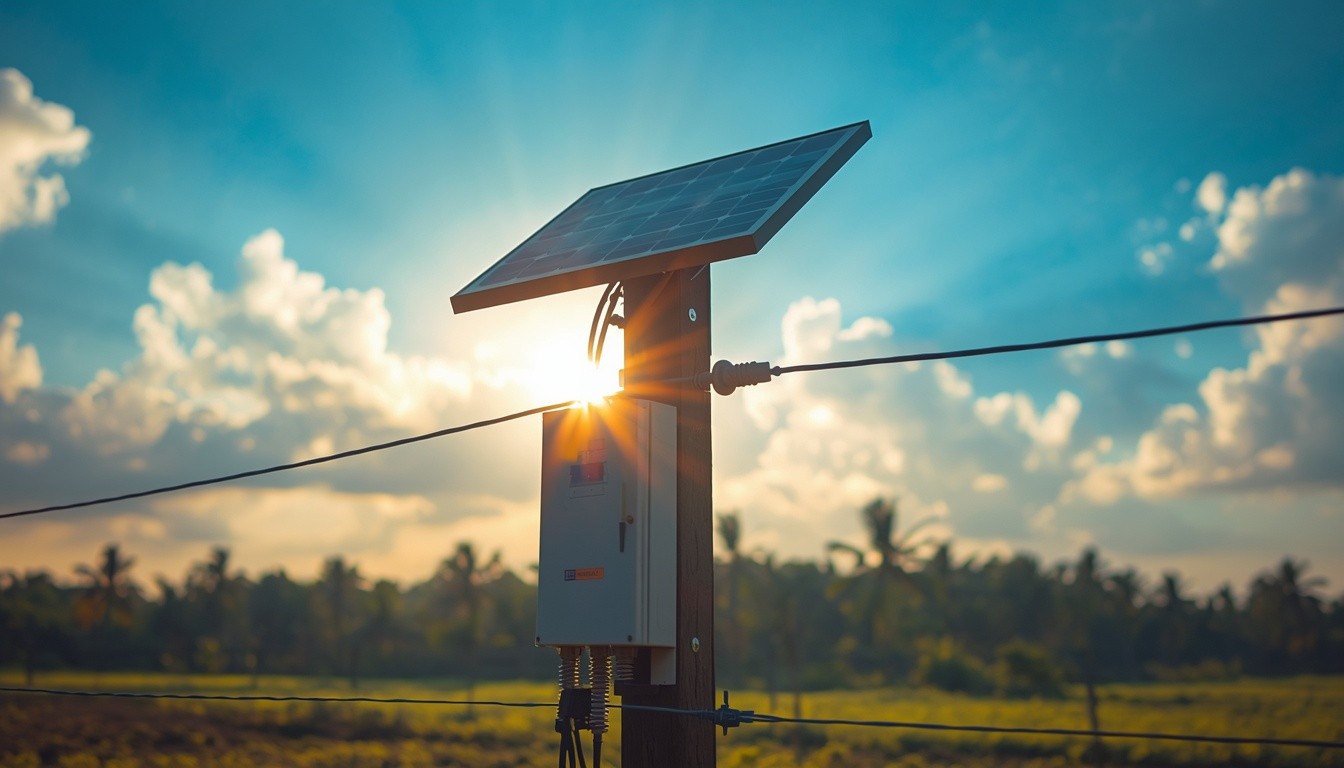
Crop damage from wildlife and livestock intrusion is one of the most persistent and costly challenges facing Indian farmers. Elephants raiding crops at night. Wild boars destroying vegetable fields. Stray cattle wandering into paddy fields. These are not occasional inconveniences they are recurring financial losses that affect farm viability and farmer livelihoods season after season.
Traditional fencing barbed wire, wooden posts, stone walls provides limited protection and requires constant maintenance. It does not deter determined wildlife. It does not work at night when most intrusions happen. And it does not address the fundamental problem that animals quickly learn to find gaps and weak points in passive barriers.
Solar electric fencing is different. It creates a psychological barrier animals that receive one deterrent shock learn to avoid the fence entirely. It works day and night. It operates completely off-grid with zero monthly electricity cost. And when installed correctly by a qualified team it requires minimal maintenance for years.
This is the complete guide to solar electric fencing for Indian farms how it works, what it costs, what installation involves, and what to look for in a qualified installer.
What Is Solar Electric Fencing?
A solar electric fence is a complete system that uses solar energy to deliver a strong but non-lethal electric pulse through a fence wire at regular intervals. When an animal touches the wire it receives a sharp deterrent shock unpleasant enough to discourage further contact but not harmful.
The key word is deterrent. Solar electric fencing does not physically prevent an animal from crossing it conditions the animal to avoid the fence through learned aversion. An elephant that receives a shock from an electric fence does not attempt to push through it. A wild boar that touches an electric fence retreats. Animals learn quickly and maintain their learned avoidance for extended periods.
This psychological deterrent effect is what makes electric fencing significantly more effective than passive physical barriers for wildlife management.
How a Solar Electric Fence System Works
A complete solar electric fence system has five main components working together:
Solar Panel: Mounted on a dedicated pole or post along the fence line. Generates DC electricity from sunlight and feeds it to the charge controller. Sized to provide enough power for the fence energiser while also charging the battery through the day.
Battery: Stores the energy generated by the solar panel. Allows the fence to operate through the night and through overcast periods without direct sunlight. The battery is the component that makes solar electric fencing a 24-hour solution not just a daytime one.
Charge Controller: Manages the flow of power from the solar panel to the battery and prevents overcharging or deep discharge. A quality charge controller extends battery life significantly and ensures the system operates reliably across all weather conditions.
Fence Energiser: The heart of the system. Takes the stored DC power from the battery and converts it into the high-voltage low-current pulses that travel through the fence wire. A quality energiser delivers a consistent deterrent pulse regardless of vegetation touching the fence wire or minor wire damage.
The pulse delivered by the energiser is designed specifically high enough voltage to create an effective deterrent shock through an animal's hide or fur but low current and short duration so it cannot cause cardiac arrest or serious injury. It is an internationally standardised safety specification.
Fence Wire and Posts: High-tensile galvanised steel wire carries the electric pulse along the fence line. Posts wooden, concrete, or fiberglass support the wire at regular intervals and include insulators to prevent the wire from grounding on the post itself. The number of wire strands, post spacing, and wire height are all designed based on the specific animals being deterred.
What Animals Can Solar Electric Fencing Deter?
Solar electric fencing is effective against a wide range of animals when the system is correctly designed for the specific threat. In India the most common applications are:
Elephants: The largest and most destructive crop raider in many parts of Karnataka, Tamil Nadu, Kerala, Assam, and Odisha. Elephants are intelligent animals that quickly learn the fence boundary when properly energised. Multi-strand high-tensile wire fencing energised at sufficient voltage is highly effective. Arush Solar Tech has installed elephant deterrent fencing at BRT Tiger Reserve and Nagarhole National Park environments where the system must work reliably under significant animal pressure.
Wild Boar: One of the most widespread and destructive crop raiders across India. Wild boar are low to the ground fencing design for boar deterrence requires lower wire strands close to the ground. They are persistent and fast learning which makes electric fencing particularly effective once the deterrent conditioning is established.
Deer and Antelope: Medium height fencing with multiple strands at varying heights is effective. Deer respond quickly to deterrent conditioning and maintain avoidance reliably.
Leopard and Other Big Cats: Where livestock predation by leopards or tigers is a concern electric fencing around livestock enclosures provides significant protection. Design requirements are specific to the predator species and local conditions.
Stray Cattle and Livestock: Common problem on farms across India where unfenced roadsides or open grazing areas allow cattle to wander into cultivated land. Electric fencing is highly effective for cattle deterrence with even a simple low-voltage single-strand installation.
Monkeys: One of the more challenging animals to deter with electric fencing but achievable with specific multi-strand designs. Common problem in agricultural areas near forests across Karnataka and other states.
Solar Electric Fencing vs Traditional Fencing
Here is a direct comparison of solar electric fencing against the traditional alternatives:
Barbed Wire Fencing: Initial cost: Low Effectiveness: Moderate against livestock, low against wildlife Maintenance: High wire rusts, posts rot, strands break and must be replaced Night effectiveness: Same as day passive barrier Wildlife response: Large animals push through or go under. Determined wildlife finds gaps quickly.
Stone Wall or Compound Wall: Initial cost: Very high Effectiveness: Good for small animals, limited for elephants Maintenance: Low once built but expensive to repair damage Night effectiveness: Same as day Wildlife response: Elephants break through or climb over stone walls. Does not deter determined animals.
Wooden Palisade Fencing: Initial cost: Moderate Effectiveness: Moderate Maintenance: High wood rots, needs regular replacement in Indian climate Night effectiveness: Same as day Wildlife response: Limited against large animals
Solar Electric Fencing: Initial cost: Moderate higher than barbed wire, lower than compound wall Effectiveness: Very high psychological deterrent effective against most species Maintenance: Low annual inspection and battery replacement every 5 to 8 years for lead acid, 10 to 15 years for lithium Night effectiveness: Full battery powered 24 hours Wildlife response: Rapid conditioning. Animals learn to avoid the fence after one or two contacts.
The total cost of ownership over 10 years factoring in maintenance and replacement costs makes solar electric fencing competitive with or cheaper than traditional fencing alternatives while delivering significantly better protection.
Solar Electric Fencing Cost in India 2026
Fencing cost depends on the perimeter length to be fenced, the number of wire strands required, the specific animals being deterred, the terrain, and the remoteness of the location.
Here are approximate cost ranges for standard agricultural solar electric fencing in India in 2026:
Per kilometre cost single strand basic system: For deterring cattle and small animals on flat accessible terrain Approximate cost: ₹80,000 - ₹1,20,000 per kilometre Includes solar panel, battery, charge controller, energiser, posts, wire, and installation
Per kilometre cost multi-strand intermediate system: For deterring wild boar, deer, and medium wildlife on standard terrain Approximate cost: ₹1,20,000 - ₹1,80,000 per kilometre Includes higher capacity solar and battery for multi-strand energiser, additional wire strands, stronger posts
Per kilometre cost heavy duty elephant deterrent system: For deterring elephants and large wildlife in areas with significant animal pressure Approximate cost: ₹1,80,000 - ₹2,80,000 per kilometre Includes high-capacity energiser, reinforced posts, multiple high-tensile wire strands, and heavy-duty solar and battery system
Typical farm perimeter costs: Small farm 1 to 2 kilometre perimeter: ₹80,000 - ₹2,40,000 Medium farm 3 to 5 kilometre perimeter: ₹2,40,000 - ₹7,00,000 Large farm 8 to 15 kilometre perimeter: ₹6,40,000 - ₹21,00,000
These are estimates. Actual costs depend on site-specific factors including terrain, access, specific system design requirements, and current material prices. A site visit and detailed assessment is required for an accurate project cost.
Are There Government Subsidies for Agricultural Solar Fencing?
Yes several state governments and the central government offer financial support for solar electric fencing for agricultural use. The specific schemes and subsidy amounts vary by state and are subject to change we recommend checking with your state agriculture department or solar nodal agency for current scheme details.
In Karnataka specifically the state government has run schemes supporting solar fencing for farmers in areas affected by wildlife depredation particularly in districts bordering forest reserves where elephant and wild boar intrusions are most severe. These schemes have typically covered 50 to 75 percent of the installation cost for eligible farmers.
Central government schemes through the Ministry of New and Renewable Energy and the Ministry of Agriculture have also included provisions for agricultural solar fencing in specific programs.
Arush Solar Tech is familiar with the current subsidy landscape for agricultural solar fencing in Karnataka and can advise you on what schemes are currently available and how to apply during the site assessment process.
Design Considerations for Your Farm
No two farm fencing projects are identical. Here are the key design factors that determine the right system for your specific situation:
Perimeter length and shape: The total fence run determines the number and placement of solar energiser units. Very long perimeters more than 2 to 3 kilometres are typically divided into independently powered sections so that a fault in one section does not disable the entire fence.
Terrain: Flat accessible agricultural land is straightforward. Rocky terrain, seasonal water crossings, and dense vegetation require specific design solutions for post installation, wire routing, and equipment protection.
Primary animal threat: Wire height, strand spacing, energiser voltage, and post strength are all designed around the specific animals being deterred. An elephant fence and a wild boar fence look very different from each other. An experienced installer designs the system for your specific threat not a generic one-size solution.
Vegetation management: Vegetation touching the fence wire reduces the pulse voltage available at the wire this is called fence load. Dense vegetation in contact with the wire can completely ground out the fence making it ineffective. Good fence design minimises vegetation contact and the energiser is sized to maintain effective voltage even with some fence load.
Distance from power source and maintenance access: Solar fencing is designed specifically for locations without reliable grid power which describes most agricultural land in India. The solar panel and battery are sized to ensure continuous operation without grid backup.
Existing fencing: Many farms have existing barbed wire or other fencing that can be electrified or integrated with a new solar energiser system potentially reducing installation cost significantly compared to building a complete new fence from scratch.
Installation Process for Solar Electric Fencing
Here is what a professional solar electric fence installation looks like from start to finish:
Site Assessment: The installer visits your farm, walks the proposed fence perimeter, identifies terrain challenges, assesses the animal threat, measures the perimeter, and designs a system specification. This is where the energiser capacity, solar panel size, battery capacity, wire strand configuration, and post placement are determined.
Material Procurement: All components are sourced based on the specific design. Quality components from established manufacturers not the cheapest available are critical for long-term reliability in agricultural environments.
Post Installation: Posts are installed at regular intervals along the fence line typically every 3 to 5 metres for standard fencing and closer for heavy-duty elephant fencing. Corner posts and strain posts are installed at changes in direction and at regular intervals along straight runs to manage wire tension.
Wire Stringing: High-tensile wire is strung between posts at the designed heights for the specific animal threat. Insulators on each post prevent the wire from grounding. Wire is tensioned to the correct level too loose and it sags and contacts vegetation, too tight and it breaks under thermal expansion and contraction.
Solar and Energiser Installation: Solar panels are mounted on dedicated poles at the designed locations along the fence line. Batteries and charge controllers are installed in weatherproof enclosures. Energisers are connected and the complete circuit is tested.
Earthing System: A proper earthing system is critical for fence effectiveness. The electric pulse travels through the fence wire to the animal and returns to the energiser through the ground. Poor earthing one of the most common installation failures results in a fence that delivers inadequate shock even when everything else is working correctly. Professional installation includes proper earthing rod installation and testing.
System Testing and Handover: The complete fence is tested with a fence tester at multiple points along the line to verify effective voltage throughout. The installer walks the complete perimeter checking for vegetation contact, wire tension, and proper insulation. The farm owner is shown how to use a fence tester, how to identify and locate faults, and how to perform basic maintenance.
Maintenance Requirements
One of the advantages of solar electric fencing over traditional fencing is the low ongoing maintenance requirement. Here is what good maintenance looks like:
Monthly Farm owner tasks: Walk the fence perimeter checking for obvious wire damage, vegetation touching the wire, fallen posts, or equipment issues. Check the fence tester reading at several points to confirm voltage is maintained. Clear vegetation from around the base of posts and away from the wire.
Quarterly Recommended check: Check battery charge levels and condition. Inspect solar panels for dust accumulation and clean if needed. Check all connections and terminals for corrosion. Verify earthing system.
Annual Professional inspection: A qualified installer inspects the complete system all components, connections, earthing, wire tension, and solar and battery performance. Replace any components showing wear or degradation.
Battery replacement: Lead acid batteries typically require replacement every 3 to 5 years in agricultural environments. Lithium batteries last 10 to 15 years. Factor replacement cost into your total ownership cost calculation.
Vegetation management Ongoing: The most important ongoing maintenance task is keeping vegetation clear of the fence wire. This is typically done by the farm owner as part of regular farm operations.
Why Choose Arush Solar Tech for Agricultural Solar Fencing
Most solar companies in India focus exclusively on rooftop solar installation. Agricultural solar fencing is a specialist capability that requires different technical knowledge, different components, and different installation experience.
Arush Solar Tech has been delivering agricultural and wildlife management solar fencing since 2018. Our track record includes:
Virajpeta Range government forest camp 2018 Nagarhole National Park complete solar fencing across one of Karnataka's most prominent wildlife reserves 2019 BRT Tiger Reserve 10 kilometres of solar electric fencing in an active tiger reserve 2021 Private mango farm, Ramanagaram agricultural fencing for private land protection Multiple government projects in forests, panchayats, and villages across Karnataka
When you engage Arush Solar Tech for agricultural fencing you are working with a team that has delivered fencing in environments significantly more demanding than a private farm active tiger reserves with real elephant and wildlife pressure. That experience is directly relevant to the reliability and effectiveness of your installation.
We design every system specifically for your farm, your terrain, and your specific animal threat. We do not apply a generic solution and hope it works. We assess, design, and install a system that is right for your specific situation.
Get a Free Assessment for Your Farm
Every agricultural solar fencing project starts with a site visit. Arush Solar Tech visits your farm across Karnataka at no cost we walk the proposed fence perimeter, assess the terrain, identify the animal threat, and prepare a detailed proposal with system specifications and accurate cost.
No obligation. No pressure. Just an honest assessment and a detailed proposal so you can make an informed decision.
Call +91-9686260065 or WhatsApp Somashekar on +91 78993 50511. Or fill in the contact form at arushsolartech.com and we will respond within 2 business hours.
Arush Solar Tech Karnataka's trusted agricultural solar fencing specialist. Serving farms, forests, and protected areas since 2018.