7 min read
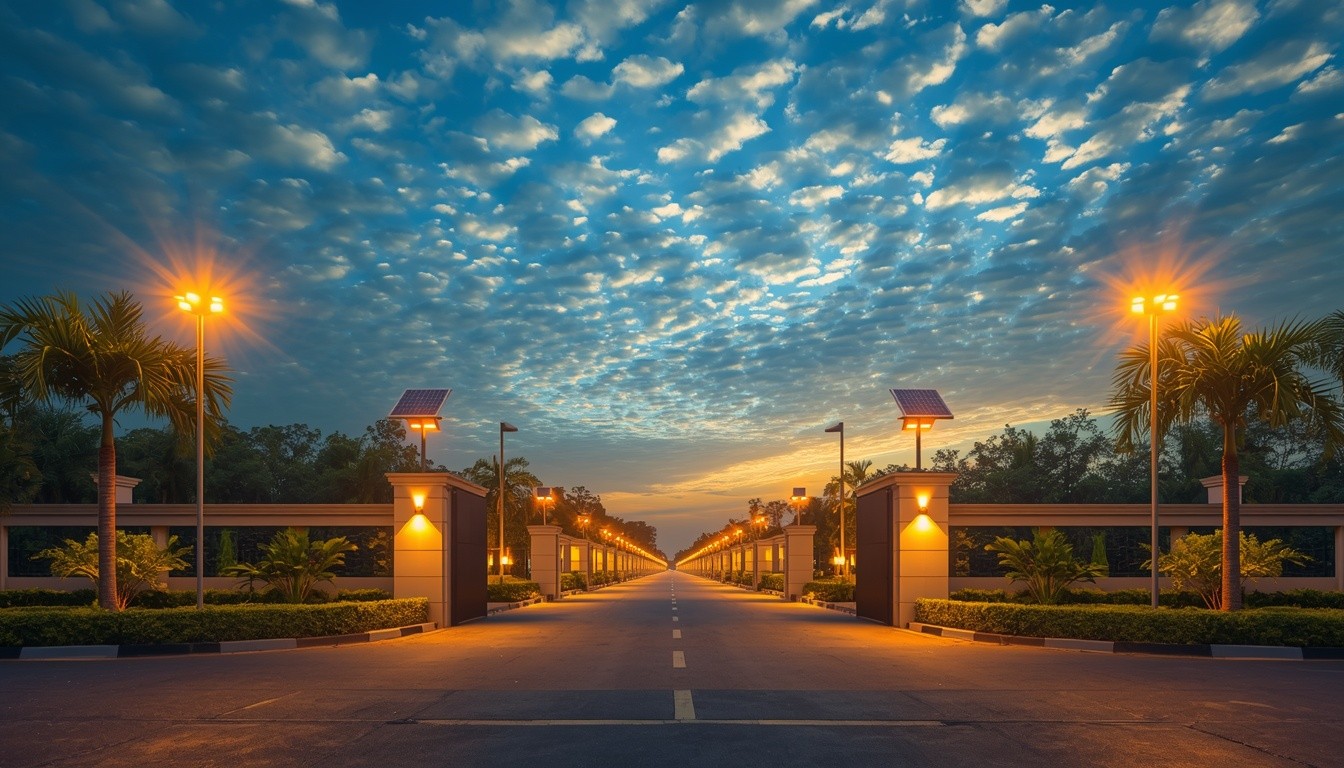
If you are on the management committee of a housing society or apartment complex in Bengaluru or anywhere across India you are almost certainly dealing with one persistent problem the monthly electricity bill for common area lighting.
Street lights, pathway lights, parking area lights, garden lights, and entrance lighting the combined electricity consumption of common area lighting in a typical housing society runs into thousands of rupees every month. Multiply that across 12 months and the annual lighting bill becomes a significant item in your society's maintenance budget.
Solar street lights eliminate that cost entirely. Each unit is completely self-contained it charges during the day from its own solar panel and powers itself through the night from its own battery. No wiring. No electricity board connection. No monthly electricity cost. No bill.
This is the complete guide to solar street lights for housing societies how they work, what they cost, what installation involves, what maintenance they need, and everything your committee needs to make an informed decision.
How Solar Street Lights Work
A modern integrated solar street light the type most commonly installed in housing societies across India in 2026 is a single self-contained unit that includes every component needed for completely autonomous operation.
Here is what is inside each unit:
Solar Panel: Mounted on the top of the light fixture or on a separate panel bracket on the pole. Generates DC electricity from sunlight throughout the day. Modern housing society solar lights typically use monocrystalline panels rated between 20 watts and 100 watts depending on the light output required.
Lithium Battery: Built into the light fixture housing. Stores the energy generated during the day and powers the LED light through the night. Modern integrated solar lights use lithium iron phosphate batteries the same chemistry used in premium residential solar storage systems for long life and reliable performance in Indian temperature conditions.
LED Light Source: High-efficiency LED chips that convert the stored battery power into bright, consistent light. Modern solar street LEDs are available in colour temperatures from warm white 3000K to cool daylight 6500K. Most housing society installations use 4000K to 5000K a neutral white that provides good visibility without the harshness of pure cool white.
Charge Controller and Smart Driver: The intelligent component that manages charging, controls light output based on battery level, and runs any smart features like motion sensing or dimming schedules. Modern solar lights include sophisticated charge controllers that extend battery life by preventing overcharging and protecting against deep discharge.
Motion Sensor (on many models): Many modern solar street lights include a passive infrared motion sensor. The light operates at reduced brightness typically 30 to 50 percent during quiet periods and brightens to full output when motion is detected. This significantly extends battery life and ensures the light is at full brightness when someone is actually present.
Pole: Galvanised steel or aluminium pole in heights from 4 metres to 8 metres depending on the installation location and required light coverage area. Pre-drilled for clean cable routing with a sealed base for easy battery and electronics access.
Types of Solar Street Lights for Housing Societies
Not all solar street lights are the same. Here are the main types you will encounter:
All-in-One Integrated Solar Street Light: The panel, battery, LED, controller, and motion sensor are all built into a single compact unit that mounts on top of the pole. No separate wiring between components. Simple installation mount the pole, attach the light unit, done. This is the most commonly installed type for housing societies and the type Arush Solar Tech most frequently recommends for residential applications.
Advantages: Simple installation, clean appearance, easy to replace or upgrade individual units. Disadvantages: The panel is fixed at the same angle as the light mounting which may not be the optimal angle for solar collection in all locations.
Split Solar Street Light: The solar panel is mounted separately from the light fixture either on a bracket above the light on the same pole or on a separate dedicated panel pole nearby. Allows the panel to be oriented at the optimal angle for solar collection regardless of the light direction.
Advantages: Better solar collection efficiency when panel orientation is constrained. Disadvantages: More complex installation, more components to maintain.
Solar Flood Lights: High-output solar powered flood lights for large open areas like parking lots, sports courts, or large entrance areas. Higher wattage LED output and larger solar panel and battery to match.
Light Output How Bright Do You Need?
Light output for solar street lights is measured in lumens. Here is a practical guide to what lumen output you need for different housing society applications:
Pathway and garden lighting: 500 to 1500 lumens per fixture For walkways, garden paths, and decorative lighting where high visibility is not the primary requirement
Standard street lighting in society roads: 2000 to 4000 lumens per fixture For internal roads, driveways, and general circulation areas. Pole height typically 5 to 6 metres. Spacing between poles typically 15 to 25 metres depending on lumen output.
Parking area lighting: 3000 to 6000 lumens per fixture For covered or open parking areas requiring clear visibility for vehicle movement and security
Entrance and gate lighting: 4000 to 8000 lumens per fixture Main entrance areas benefit from higher output for visibility, security, and the impression the entrance creates for residents and visitors
Large open areas sports courts, community areas: 8000 to 20000 lumens per fixture using solar flood lights High-output applications requiring multiple fixtures or high-wattage flood light units
Cost of Solar Street Lights in India 2026
Solar street light costs vary based on light output, battery capacity, pole height, and brand. Here are realistic price ranges for quality integrated solar street lights in India in 2026:
Small pathway and garden lights 500 to 1500 lumens: Cost per unit including pole and installation: ₹4,000 - ₹8,000 Battery backup: 2 to 3 nights of overcast days Best for: Garden paths, decorative lighting, low-traffic walkways
Standard street lights 2000 to 4000 lumens: Cost per unit including pole and installation: ₹8,000 - ₹18,000 Battery backup: 2 to 3 nights Best for: Internal society roads, driveways, standard circulation areas
High output street lights 4000 to 8000 lumens: Cost per unit including pole and installation: ₹15,000 - ₹30,000 Battery backup: 2 to 3 nights Best for: Entrance areas, parking lots, main internal roads requiring strong visibility
Solar flood lights 8000 to 20000 lumens: Cost per unit including pole and installation: ₹25,000 - ₹60,000 Battery backup: 1 to 2 nights Best for: Large open areas, sports courts, commercial parking
Typical housing society project costs: Small society 20 to 40 lights: ₹2,00,000 - ₹7,20,000 Medium society 40 to 80 lights: ₹4,00,000 - ₹14,40,000 Large society 80 to 150 lights: ₹8,00,000 - ₹27,00,000
These are estimates. Actual costs depend on the specific light output required, pole heights, site conditions, and current material prices.
Return on Investment for Housing Societies
Solar street lights eliminate your common area lighting electricity cost entirely. Here is how to calculate the return on investment for your society:
Step 1 Calculate current annual lighting cost: Find your society's monthly electricity bill for common area lighting. Multiply by 12 to get the annual cost.
Step 2 Estimate solar street light investment: Get a detailed quote from a qualified installer for the number and type of lights your society needs.
Step 3 Calculate payback period: Investment divided by annual savings equals payback period in years.
Example calculation Medium housing society in Bengaluru: Current common area electricity bill: ₹25,000 per month ₹3,00,000 per year Solar street light investment for 60 lights: ₹9,00,000 including installation Annual saving: ₹3,00,000 per year Payback period: 3 years Savings over 10 years: ₹30,00,000 minus ₹9,00,000 investment equals ₹21,00,000 net saving
After payback the society saves the full ₹3,00,000 per year indefinitely reducing maintenance charges for residents or funding other society improvements.
This calculation does not account for BESCOM tariff increases which will make the annual saving larger every year further improving the actual return.
No Wiring What That Actually Means for Your Society
The single most significant practical advantage of solar street lights for existing housing societies is the complete elimination of underground or overhead wiring.
Installing conventional grid-connected street lights in an existing housing society requires:
Trenching digging cable trenches along every road, pathway, and area where lights are needed Underground conduit installation Cable laying through conduits Backfilling and road surface reinstatement Distribution box installation BESCOM connection extension or new meter All associated civil work costs
In an established housing society with existing roads, landscaping, and underground services this civil work is expensive, disruptive, and time-consuming. It damages existing roads and landscaping that then need to be restored.
Solar street lights require none of this. Each pole is a standalone unit. A concrete foundation is poured for each pole a simple operation that requires a small excavation at each pole location only. The pole is installed. The light is mounted and commissioned. No trenching. No cable laying. No civil reinstatement.
The saving on civil work alone often represents 30 to 50 percent of the total conventional lighting project cost making solar street lights not just operationally cheaper but frequently cheaper to install than grid-connected alternatives in existing societies.
Performance During Monsoon Season
This is the question every committee member asks what happens to the lights during Bengaluru's monsoon season?
Modern quality solar street lights are designed specifically to handle Indian monsoon conditions. Here is what actually happens:
Cloudy days reduce charging: On heavily overcast monsoon days the solar panel generates less power than on clear days similar to what happens with rooftop solar systems. The battery charges to a lower level than on a clear day.
Battery backup handles consecutive overcast days: Quality solar street lights include batteries sized to provide two to three nights of full operation even after consecutive overcast days with minimal charging. This means the lights continue to function normally through typical monsoon overcast periods.
Rain does not damage the units: All quality solar street light units carry IP65 or IP66 weatherproofing ratings completely sealed against rain from any direction. Heavy monsoon rainfall poses no risk to a properly rated solar street light.
Extended monsoon overcast can reduce brightness: During extended periods of very heavy cloud cover lasting more than two to three consecutive days the smart charge controller may reduce light output to extend battery life. This is a designed-in feature the light stays on at reduced brightness rather than going dark entirely.
After rain lights perform better: Rain washes dust off the solar panels the same natural cleaning benefit that applies to rooftop solar systems. The first clear days after monsoon typically show improved light performance as clean panels charge the battery more efficiently.
What to Look for When Buying Solar Street Lights
Not all solar street lights sold in India are equal in quality. Here is what to look for and what to avoid:
Panel quality Monocrystalline panels are significantly more efficient than polycrystalline in the same physical size particularly important for integrated lights where panel size is constrained. Specify monocrystalline.
Battery chemistry: Lithium iron phosphate batteries are the correct specification for a 2026 installation. Lead acid batteries are cheaper but have a shorter lifespan 2 to 4 years versus 8 to 12 years for lithium and perform poorly in high temperatures. The battery replacement cost and disruption over a 10-year period makes lead acid more expensive in total than lithium despite the lower initial cost.
IP rating: IP65 minimum for all components. IP66 preferred. Do not accept lights rated below IP65 for outdoor installation in Indian monsoon conditions.
Lumen output verification: Ask for independent photometric test reports verifying the claimed lumen output. Many low-quality solar lights claim lumen outputs that bear no relation to actual measured output. A quality supplier can provide independent test certification.
Warranty: Two-year minimum warranty on the complete unit. Five-year warranty on the LED component. Confirm that the warranty is backed by a local service capability an overseas manufacturer warranty with no local service presence is effectively worthless.
Brand and track record: Choose established brands with a track record in India. Avoid unknown brands with no local service presence regardless of how attractive the price looks. A failed solar street light that cannot be serviced is a liability not a saving.
Installation Process for Housing Society Solar Street Lights
Here is what a professional solar street light installation looks like from assessment to completion:
Site Assessment: The installer visits your society, maps all lighting locations, assesses ground conditions for pole installation, identifies any shading factors that might affect panel charging at specific locations, and recommends light output levels for each area.
Lighting Layout Design: Based on the assessment the installer prepares a lighting layout showing pole locations, pole heights, light output levels for each area, and the total number of units required. A good lighting layout balances coverage, uniformity, and cost avoiding both dark areas and unnecessary over-lighting.
Foundation Installation: A concrete foundation is cast at each pole location. Foundation depth and dimensions depend on pole height and soil conditions. Foundations need to cure for 24 to 48 hours before pole installation.
Pole Installation: Galvanised steel poles are installed on the cured foundations and secured with anchor bolts. Poles are checked for vertical alignment before final tightening.
Light Unit Mounting and Commissioning: Integrated solar light units are mounted and secured on each pole. The charge controller is configured for local conditions charging parameters, motion sensitivity, dimming schedule if required. Each unit is tested for correct operation before the installation team leaves the site.
Handover and Documentation: The complete installation is handed over with documentation including warranty certificates for all units, commissioning test records, and maintenance guidance.
Maintenance Requirements
Solar street lights are significantly lower maintenance than conventional street lights. Here is a realistic maintenance schedule:
Monthly Society maintenance staff: Visual inspection of all units for obvious damage. Check that all lights are operating at dusk. Clear any vegetation growth that has reached panel height and might shade the panel.
Quarterly Recommended: Clean solar panel surfaces with a soft damp cloth to remove dust accumulation. Check pole bases for any corrosion or damage. Verify motion sensor operation if fitted.
Annual Professional inspection: Check all electrical connections, battery condition indicators, and charge controller settings. Clean panels thoroughly. Inspect poles and foundations for any structural issues. Check weatherproof sealing on all units.
Battery replacement Lithium iron phosphate: Lithium batteries in quality solar street lights last 8 to 12 years. Battery replacement at end of life is a straightforward procedure remove the old battery pack, install the new one, recommission the unit. Cost per unit: ₹3,000 - ₹8,000 depending on battery capacity.
LED replacement: Quality LEDs in solar street lights last 50,000 hours or more equivalent to more than 13 years of operation at 10 hours per night. LED replacement is rarely required within the first decade of operation.
How to Get Approval in Your Housing Society
Getting approval for a solar street light installation in a housing society typically involves the following process:
Step 1 Get a detailed proposal: Engage a qualified installer to assess your society and prepare a detailed proposal with lighting layout, specifications, costs, and projected savings. A detailed professional proposal makes committee approval significantly easier.
Step 2 Present the financial case: Present the current annual lighting cost versus the solar investment and payback period. A 3-year payback on a 15-year product life is a compelling financial case for most committee members.
Step 3 Committee resolution: Most housing societies require a formal committee resolution to approve capital expenditure above a certain threshold. Confirm the approval threshold in your society's bylaws and follow the required process.
Step 4 Resident communication: Inform residents about the planned installation, the expected benefits, and any temporary disruption during installation. Solar street light installation is minimally disruptive typically 2 to 5 days for a standard society installation but advance communication avoids complaints.
Step 5 Installation and handover: Once approved the installation proceeds as described above. Completion is followed by formal handover documentation for the society's records.
Why Choose Arush Solar Tech for Your Housing Society
Arush Solar Tech has delivered solar street light installations across Karnataka since 2018 including projects at Nagarhole National Park, BRT Tiger Reserve, Kaav Resort in Kabini, and multiple government facilities. We understand what reliable solar lighting looks like in demanding real-world conditions.
For housing society installations we bring that same standard of quality assessment, component specification, and installation workmanship to your property. We do not recommend the cheapest available lights we recommend the right lights for your specific application with components that will perform reliably for the next decade with minimal maintenance.
Every Arush Solar Tech housing society installation includes:
Detailed site assessment and lighting layout at no cost Component specifications from established quality manufacturers Professional installation by our certified team Complete commissioning testing before handover Warranty documentation for all units Post-installation support from the same team that did the installation
Book a Free Society Assessment
Arush Solar Tech provides free site assessments and detailed proposals for housing societies across Bengaluru and Karnataka. Our team visits your society, prepares a complete lighting layout, and gives you detailed specifications and accurate costs at no obligation and no cost.
Call +91-9686260065 or WhatsApp Somashekar on +91 78993 50511. Or fill in the contact form at arushsolartech.com and we will respond within 2 business hours.
Arush Solar Tech Karnataka's trusted solar installation partner for housing societies, government projects, and residential rooftops since 2018.